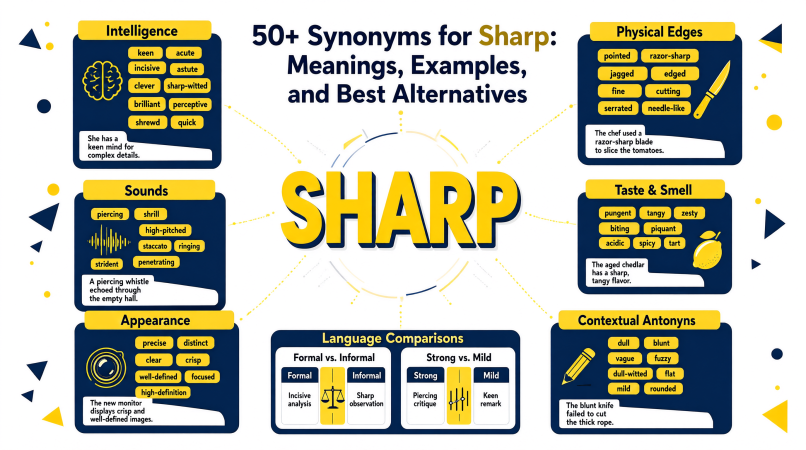
Sharp describes something with a fine edge, a pointed shape, strong intensity, or quick intelligence. Its best synonyms include keen, acute, pointed, incisive, intelligent, perceptive, crisp, piercing, and astute, depending on the context and intended meaning.
Do you find yourself using the word sharp repeatedly when describing someone’s intelligence, a knife’s edge, a strong flavor, or a sudden change? Although it is a useful English word, repeating it can make your writing sound less descriptive.
Finding the right alternative can make your essays, emails, professional documents, social media captions, and everyday conversations more interesting and precise.
The best synonym for sharp depends on what you want to describe. A sharp mind might be described as intelligent or perceptive, while a sharp blade might be called keen or razor edged. Understanding these differences helps you choose words that communicate exactly what you mean.
Meaning, Tone and Context
Simple Definition
The word sharp has several meanings in English. It commonly describes something with a fine cutting edge or pointed tip, but it can also refer to intelligence, strong sensations, sudden changes, or clear details.
For example, a sharp knife has a keen edge, a sharp student learns quickly, and a sharp sound is high pitched or piercing.
Part of Speech
Sharp is primarily an adjective. It describes the qualities or characteristics of a person, object, sound, taste, or situation.
It can also appear in different grammatical forms and expressions.
| Word Form | Meaning | Example |
| Sharp | Having a fine edge or quick intelligence | She has a sharp mind. |
| Sharply | In a sudden, clear, or intense manner | Prices increased sharply. |
| Sharpness | The quality of being sharp | The sharpness of the blade was impressive. |
| Sharpen | To make something sharper | He sharpened the kitchen knife. |
| Sharpened | Made sharper or more precise | She sharpened her writing skills. |
Positive, Negative, or Neutral Tone
Sharp can communicate positive, negative, or neutral meanings depending on the situation.
Positive tone: When describing intelligence, awareness, or precision.
Example: She is a sharp and thoughtful student.
Negative tone: When describing harsh comments, unpleasant sounds, or painful sensations.
Example: His sharp response upset everyone.
Neutral tone: When describing an object’s edge, a clear image, or a sudden change.
Example: This knife has a sharp blade.
Formality Level
Sharp is a common word that works in formal, informal, academic, and professional communication.
However, more specific alternatives can improve precision in certain situations.
| Context | Suitable Alternatives |
| Formal writing | Acute, incisive, precise |
| Academic writing | Distinct, acute, perceptive |
| Professional communication | Astute, analytical, precise |
| Casual conversation | Smart, clever, quick |
| Creative writing | Piercing, razor keen, biting |
| Descriptive writing | Pointed, crisp, cutting |
Common Uses of Sharp
The word sharp appears in several everyday situations.
- Physical objects: A sharp knife, needle, blade, or tool.
- Intelligence: A sharp mind, clever observation, or quick thinker.
- Sounds: A sharp whistle, piercing noise, or high pitched tone.
- Taste and smell: A sharp flavor, pungent smell, or acidic taste.
- Appearance: Sharp features, clear photographs, or defined edges.
- Emotions: Sharp pain, harsh criticism, or biting remarks.
- Changes: A sharp increase, sudden decline, or steep turn.
- Time: Leaving at 9 sharp means leaving exactly at 9.
When and How to Use “Sharp”
Use sharp when you want to describe something that has a fine edge, strong intensity, clear definition, or quick mental ability.
The following examples demonstrate how the word works in different situations.
- Professional: Our company needs sharp decision making to remain competitive.
- Personal: My younger brother has a sharp memory and rarely forgets anything.
- Academic: The student demonstrated sharp analytical skills during the examination.
- Emotional: Her sharp comments made the conversation uncomfortable.
- Creative: A sharp wind swept across the empty streets.
- Social media: Stay sharp, stay focused, and keep chasing your goals.
- Casual: That was a sharp observation. You noticed something everyone else missed.
Another Word for “Sharp”
There is no single synonym that replaces sharp in every situation. The best alternative depends on whether you are describing an edge, intelligence, sound, taste, appearance, or intensity.
Here are useful recommendations for different writing situations.
| Context | Best Alternative | Example |
| Professional writing | Astute | She made an astute business decision. |
| Academic writing | Acute | The researcher demonstrated acute awareness. |
| Casual conversation | Smart | He is a smart guy. |
| Emotional writing | Piercing | She gave him a piercing look. |
| Creative writing | Keen | A keen blade glimmered in the sunlight. |
| Resume or workplace | Analytical | Demonstrated strong analytical abilities. |
| Social media captions | Clever | Stay clever and keep moving forward. |
| Stronger meaning | Incisive | She delivered an incisive argument. |
| Softer meaning | Clear | The photograph has clear details. |
Best Alternatives by Meaning
Sharp blade: Keen, razor edged, pointed, cutting.
For a sharp mind: Intelligent, astute, perceptive, clever, quick witted.
For a sharp sound: Piercing, shrill, high pitched, penetrating.
Sharp taste: Pungent, acidic, tangy, spicy.
For sharp criticism: Biting, cutting, scathing, caustic.
For sharp images: Crisp, clear, distinct, well defined.
Sharp increase: Sudden, steep, dramatic, considerable.
When Not to Use “Sharp”
Although sharp is versatile, it can sometimes sound too general when a more specific word would communicate your meaning better.
Consider these examples.
| Original Sentence | Better Alternative | Why It Works |
| She has a sharp mind. | She has an astute mind. | Highlights good judgment. |
| The knife is sharp. | The knife has a keen edge. | Describes the cutting edge more precisely. |
| He made a sharp comment. | He made a biting comment. | Communicates a hurtful or sarcastic tone. |
| The photograph is sharp. | The photograph is crisp and clear. | Describes image quality more naturally. |
| There was a sharp increase in sales. | There was a steep increase in sales. | Communicates a substantial change. |
| I heard a sharp noise. | I heard a piercing noise. | Emphasizes the intensity of the sound. |
Avoid using complicated vocabulary simply to replace familiar words. A good synonym should make your sentence more accurate, not more confusing.
Words Commonly Confused With “Sharp”
Several English words have similar meanings to sharp, but they are not always interchangeable.
| Word | Meaning | Difference From Sharp |
| Keen | Having a fine edge or strong enthusiasm | Often emphasizes eagerness or a finely cutting edge. |
| Acute | Very strong, severe, or highly developed | Common in medical and intellectual contexts. |
| Pointed | Having a narrow or sharp tip | Primarily describes physical shape or direct remarks. |
| Clever | Quick at learning, understanding, or solving problems | Focuses on mental ability. |
| Incisive | Clear, direct, and intelligently analytical | Commonly describes arguments and observations. |
| Piercing | Extremely sharp, intense, or penetrating | Often describes sounds, looks, or sensations. |
Understanding these distinctions helps you choose the right word for the intended meaning.
Best Synonym by Context for Sharp
The following table highlights suitable alternatives for different writing situations.
| Context | Best Synonym | Why It Works | Example |
| Formal writing | Acute | Sounds precise and professional | She demonstrated acute awareness. |
| Academic writing | Incisive | Communicates analytical ability | The paper presents an incisive argument. |
| Professional use | Astute | Highlights good judgment | He made an astute investment decision. |
| Resume | Analytical | Demonstrates reasoning skills | Applied analytical thinking to complex problems. |
| Casual conversation | Smart | Natural and familiar | That was a smart idea. |
| Creative writing | Piercing | Creates strong imagery | A piercing cry echoed through the forest. |
| Emotional writing | Cutting | Communicates hurtful remarks | His cutting words stayed with her. |
| Strong intensity | Razor sharp | Emphasizes exceptional sharpness | The blade was razor sharp. |
| Softer meaning | Clear | Communicates definition | The image looks clear. |
| Social media captions | Clever | Sounds natural and engaging | Clever minds create new possibilities. |
| Describing taste | Pungent | Communicates a strong flavor or smell | The cheese had a pungent aroma. |
| Describing sound | Shrill | Describes a high pitched sound | A shrill whistle interrupted the game. |
| Describing vision | Keen | Suggests strong visual ability | She has keen eyesight. |
| Describing an increase | Steep | Communicates a substantial rise | Prices experienced a steep increase. |
| Describing appearance | Defined | Highlights clear shapes or features | He has well defined facial features. |
| Describing criticism | Scathing | Communicates severe disapproval | The review contained scathing criticism. |
Which Synonym Should You Choose?
Choosing the best synonym for sharp requires understanding the sentence rather than simply selecting another word from a vocabulary list.
Use this practical decision guide.
- Identify the meaning: Decide whether sharp describes an object, person, sound, taste, image, or situation.
- Consider formality: Use astute, acute, and incisive in suitable formal contexts. Choose smart or clever in everyday conversations.
- Check emotional intensity: Piercing, biting, and scathing create stronger impressions than clear or distinct.
- Think about professional value: For resumes and business communication, words such as analytical, perceptive, and astute can communicate useful abilities.
- Avoid unnecessary complexity: If sharp communicates your meaning perfectly, there is no reason to replace it.
- Read the sentence again: Make sure your chosen alternative sounds natural and preserves the original meaning.
Real Life Examples of Sharp in Sentences
Here are practical examples showing how sharp and its stronger alternatives work in everyday English.
| Situation | Example Sentence |
| School | The student demonstrated exceptional analytical thinking. |
| Workplace | Her astute decisions helped the company improve its performance. |
| Academic writing | The researcher provided an incisive analysis of the results. |
| Conversation | You are really clever for figuring that out so quickly. |
| Social media | Keep your mind sharp and your ambitions bigger. |
| Resume | Demonstrated keen problem solving and analytical abilities. |
| Thank you for your insightful observations during the meeting. | |
| Storytelling | A piercing scream broke the silence of the night. |
| Photography | The camera captured crisp details in every photograph. |
| Business | The company experienced a steep increase in operating costs. |
25 Synonyms for Sharp
Below are 25 useful alternatives covering physical sharpness, intelligence, sound, taste, and descriptive writing.
Some words are direct synonyms in particular contexts, while others are related alternatives that work only when the intended meaning matches.
| Synonym | Simple Meaning | Best Used For | Example Sentence |
| Keen | Having a fine edge or strong awareness | Blades and intelligence | The chef used a keen knife. |
| Acute | Extremely strong or highly developed | Intelligence and sensations | She has an acute sense of observation. |
| Pointed | Having a sharp tip or direct meaning | Objects and comments | He made a pointed remark. |
| Incisive | Clear, intelligent, and analytical | Arguments and writing | Her incisive comments improved the discussion. |
| Astute | Showing good judgment | Business and intelligence | He is an astute businessman. |
| Perceptive | Quick to notice and understand things | People and observations | She is highly perceptive. |
| Clever | Quick at understanding or solving problems | Casual and professional communication | That was a clever solution. |
| Intelligent | Having strong mental ability | Academic and personal descriptions | He is an intelligent student. |
| Smart | Showing intelligence or good judgment | Everyday conversations | She made a smart choice. |
| Shrewd | Practical and clever in decision making | Business and negotiations | The investor made a shrewd move. |
| Quick witted | Able to respond intelligently and quickly | Conversation and humor | His quick witted response surprised everyone. |
| Piercing | Extremely intense or penetrating | Sounds and looks | A piercing whistle filled the room. |
| Penetrating | Deeply perceptive or able to pass through | Analysis and sensations | She asked a penetrating question. |
| Cutting | Having a fine edge or causing emotional hurt | Blades and criticism | His cutting remarks offended her. |
| Biting | Harsh, critical, or sarcastic | Humor and criticism | The article contained biting humor. |
| Scathing | Extremely critical | Reviews and arguments | The newspaper published a scathing review. |
| Caustic | Sarcastic or severely critical | Literary and professional criticism | His caustic comments created tension. |
| Crisp | Clear, fresh, or sharply defined | Images, sounds, and descriptions | The photograph looked crisp. |
| Distinct | Clearly recognizable or different | Images and features | The picture showed distinct details. |
| Precise | Exact and accurate | Professional and academic writing | Her precise explanation solved the problem. |
| Pungent | Having a strong smell or taste | Food and sensory descriptions | The cheese had a pungent smell. |
| Shrill | High pitched and piercing | Sounds and voices | A shrill alarm woke everyone. |
| Tangy | Having a pleasantly strong or acidic flavor | Food descriptions | The sauce had a tangy flavor. |
| Steep | Rising or falling sharply | Prices, roads, and statistics | The company faced a steep increase in costs. |
| Sudden | Happening quickly or unexpectedly | Changes and movements | A sudden turn surprised the driver. |
Synonym Groups and Usage Differences
Professional vs. Personal Synonyms
Professional writing often requires words that communicate intelligence, judgment, and accuracy.
Words such as astute, analytical, perceptive, and incisive are useful in business documents, reports, presentations, and workplace communication.
Personal writing can be more expressive and conversational.
For example:
Professional: She demonstrated astute decision making during the project.
Personal: She is incredibly smart and always knows what to do.
Both sentences describe intelligence, but their tones are different.
Formal vs. Conversational Synonyms
Formal vocabulary is useful in academic essays, professional reports, business emails, and presentations.
Conversational alternatives work better in everyday discussions, messages, and informal writing.
| Formal Synonym | Conversational Alternative |
| Astute | Smart |
| Incisive | Clever |
| Perceptive | Quick to notice |
| Acute | Very strong |
| Precise | Exact |
| Scathing | Very critical |
| Pungent | Strong smelling |
Choose vocabulary based on your audience. A formal word may improve a report but sound unnatural in a casual text message.
Academic Synonyms
Academic writing benefits from words that communicate specific intellectual qualities.
Useful alternatives include:
- Incisive: Suitable for describing a clear and analytical argument.
- Acute: Useful when discussing strong awareness or sensitivity.
- Perceptive: Describes someone who understands complex ideas.
- Analytical: Communicates careful examination and reasoning.
- Precise: Highlights accuracy and attention to detail.
- Discerning: Describes the ability to recognize important differences.
Example:
Instead of writing, “The author has a sharp understanding of the issue,” write, “The author demonstrates a perceptive understanding of the issue.”
The revised sentence sounds more specific and academically appropriate.
Professional and Business Synonyms
In business communication, sharp often describes intelligence, decision making, attention, and professional skills.
Useful alternatives include:
| Synonym | Workplace Application |
| Astute | Business judgment |
| Analytical | Problem solving |
| Perceptive | Understanding customer needs |
| Discerning | Evaluating opportunities |
| Precise | Accurate communication |
| Strategic | Planning and decision making |
| Insightful | Offering valuable observations |
Resume example:
“Demonstrated strong analytical abilities and strategic thinking while managing complex projects.”
This is more informative than simply describing yourself as sharp.
Creative or Literary Synonyms
Creative writing uses expressive vocabulary to help readers imagine scenes, sounds, and emotions.
Useful alternatives include:
- Piercing: Creates an intense impression.
- Razor sharp: Emphasizes exceptional sharpness.
- Biting: Adds sarcasm or criticism.
- Crystalline: Suggests exceptional clarity.
- Keen: Creates a sense of precision.
- Cutting: Communicates emotional intensity.
- Shrill: Describes an unpleasant high pitched sound.
Example:
“A piercing wind swept through the narrow streets, rattling the windows.”
This creates a stronger image than simply saying, “A sharp wind blew through the streets.”
Slang or Modern Synonyms
Sharp does not have one universal modern slang replacement. However, several informal words can communicate similar ideas when describing intelligence.
| Informal Word | Meaning | Usage |
| Smart | Intelligent | Everyday conversations |
| Clever | Good at solving problems | Casual discussions |
| Quick witted | Fast and intelligent in responses | Humor and conversation |
| Brainy | Very intelligent | Informal descriptions |
| Sharp minded | Mentally alert | Casual and professional use |
| On the ball | Alert and capable | Workplace and everyday speech |
For example:
“She is really on the ball during meetings.”
This means she is alert, understands what is happening, and responds effectively.
Avoid using informal expressions such as brainy in formal research papers or professional reports.
Strongest vs. Weaker Synonyms
Different alternatives communicate different levels of intensity.
The following scale is useful when describing criticism, sounds, sensations, and physical sharpness.
| Intensity | Word | Impression |
| Mild | Clear | Easy to understand or recognize |
| Moderate | Distinct | Noticeably defined |
| Strong | Keen | Very sharp or highly aware |
| Very strong | Piercing | Intensely penetrating |
| Very strong | Razor sharp | Exceptionally sharp |
| Severe | Scathing | Extremely critical |
| Severe | Caustic | Harsh and potentially hurtful |
This scale is contextual. For example, scathing is stronger than biting when describing criticism, but it cannot replace sharp when describing a knife.
Emotional vs. Neutral Synonyms
Neutral alternatives describe qualities without necessarily expressing strong emotions.
Examples include:
- Precise
- Distinct
- Clear
- Keen
- Acute
Emotional or expressive alternatives communicate stronger feelings.
Examples include:
- Cutting
- Biting
- Piercing
- Caustic
- Scathing
Compare these sentences:
Neutral: She made a precise observation about the situation.
Emotional: She made a cutting remark about his behavior.
The first communicates accuracy, while the second suggests an emotionally hurtful comment.
Antonyms of Sharp
The opposite of sharp depends on the meaning of the word.
For example, the opposite of a sharp blade is blunt, while the opposite of a sharp mind might be dull or slow.
Here are 15 contextual antonyms.
| Antonym | Meaning | Example Sentence |
| Dull | Lacking a sharp edge or mental brightness | The old knife became dull. |
| Blunt | Having a rounded or ineffective edge | The scissors are blunt. |
| Rounded | Having a curved rather than pointed shape | The object has a rounded tip. |
| Smooth | Having an even surface without rough edges | The stone has a smooth surface. |
| Flat | Lacking a pointed or raised shape | The blade has a flat edge. |
| Obtuse | Not sharp in angle or slow to understand | The triangle has an obtuse angle. |
| Dim | Lacking brightness or mental clarity | The room was dimly lit. |
| Unintelligent | Lacking strong intellectual ability | The description was unfairly judgmental. |
| Slow | Taking more time to understand or react | He was slow to recognize the problem. |
| Vague | Not clearly expressed or defined | Her explanation was vague. |
| Blurred | Lacking clear visual definition | The photograph looked blurred. |
| Indistinct | Not clearly recognizable | The distant figures were indistinct. |
| Mild | Not strong or intense | The sauce had a mild flavor. |
| Gentle | Soft rather than harsh or forceful | She gave him a gentle response. |
| Gradual | Happening slowly rather than suddenly | The company experienced gradual growth. |
These are contextual opposites rather than universal dictionary antonyms. The appropriate choice depends on whether sharp describes an edge, angle, mind, image, sensation, or change.
Comparison: Sharp vs. Similar Words
Understanding the differences between similar words can help you select the most accurate alternative.
Sharp vs. Keen
Main difference: Sharp often describes an edge, strong sensation, or intelligence. Keen can describe a fine edge, strong interest, or excellent awareness.
Which is stronger? Both can describe a very fine edge. Keen often emphasizes enthusiasm or awareness.
Which is more formal? Both are suitable for formal writing.
Examples:
- The knife has a sharp blade.
- She has a keen interest in science.
Sharp vs. Acute
Main difference: Sharp has several everyday meanings, while acute often describes something intense, severe, or highly developed.
Which is stronger? Acute often suggests a particularly intense or developed quality.
Which is more formal? Acute is generally more technical and formal.
Examples:
- He experienced a sharp pain in his shoulder.
- The patient reported acute pain.
Sharp vs. Pointed
Main difference: Sharp emphasizes an edge or intensity, while pointed emphasizes a narrow tip or a direct remark.
Which is stronger? Sharp can communicate greater intensity, depending on context.
Which is more formal? Both are suitable for formal and informal writing.
Examples:
- The knife has a sharp edge.
- The needle has a pointed tip.
Sharp vs. Clever
Main difference: Sharp can describe intelligence and awareness, while clever specifically emphasizes the ability to solve problems or think creatively.
Which is stronger? Sharp can suggest broader mental alertness, while clever emphasizes ingenuity.
Which is more formal? Both are common in everyday and professional English.
Examples:
- She is a sharp businesswoman.
- She found a clever solution to the problem.
Sharp vs. Incisive
Main difference: Sharp can describe general intelligence or intensity, while incisive specifically describes clear and intelligent analysis.
Which is stronger? Incisive often conveys a more focused analytical quality.
Which is more formal? Incisive is more formal and academic.
Examples:
- He is known for his sharp observations.
- He delivered an incisive analysis of the situation.
Sharp vs. Piercing
Main difference: Sharp describes something intense or clearly defined, while piercing emphasizes the ability to penetrate or create an intense sensation.
Which is stronger? Piercing often creates a more intense sensory impression.
Which is more formal? Both can be used in formal writing.
Examples:
- A sharp sound came from the hallway.
- A piercing scream echoed through the building.
Common Phrases and Expressions with Sharp
Sharp appears in many common English expressions. Understanding them can help you sound more natural in everyday conversations and professional communication.
1. Sharp as a Tack
Meaning: Very intelligent or mentally alert.
Example sentence: My grandmother is 85, but she is still as sharp as a tack.
2. Razor Sharp
Meaning: Extremely sharp, precise, or intelligent.
Example sentence: The chef keeps his kitchen knives razor sharp.
3. At 9 O’Clock Sharp
Meaning: Exactly at the stated time.
Example sentence: The meeting will begin at 9 o’clock sharp.
4. Look Sharp
Meaning: To pay attention, be alert, or improve one’s appearance.
Example sentence: Look sharp when crossing the busy street.
5. Sharp Tongue
Meaning: A tendency to speak critically or make harsh remarks.
Example sentence: Her sharp tongue sometimes gets her into trouble.
6. Sharp as a Needle
Meaning: Extremely intelligent, alert, or perceptive.
Example sentence: The young detective was sharp as a needle.
7. Come to a Sharp Stop
Meaning: To stop suddenly or abruptly.
Example sentence: The car came to a sharp stop near the intersection.
8. Sharp Turn
Meaning: A sudden or steep change in direction.
Example sentence: The driver slowed down before taking the sharp turn.
Common Mistakes to Avoid
Even experienced English speakers sometimes choose synonyms that do not communicate their intended meaning.
Here are seven common mistakes worth avoiding.
1. Using Sharp When a More Precise Word Is Better
Sharp is versatile, but it may not communicate the exact meaning you want.
Incorrect: The researcher made a sharp analysis.
Better: The researcher provided an incisive analysis.
Incisive is more appropriate when describing intelligent and focused analysis.
2. Confusing Sharp With Keen
Although keen and sharp overlap, they have different uses.
For example, keen interest is a natural expression, while sharp interest is less common.
Choose the alternative that sounds natural in the sentence.
3. Using Casual Synonyms in Formal Writing
Words such as smart and brainy can work in conversations, but they may not communicate the right professional tone.
Instead, consider astute, perceptive, or analytical when discussing professional abilities.
4. Using Overly Dramatic Synonyms
Words such as scathing, piercing, and caustic communicate strong intensity.
Do not use them when describing something ordinary.
For example, a simple comment does not necessarily need to be described as scathing.
5. Repeating Sharp Too Often
Repeating the same adjective can make writing sound monotonous.
Instead of writing:
“She has a sharp mind, sharp observations, and sharp thinking.”
Try:
“She is intelligent, perceptive, and quick witted.”
6. Choosing the Wrong Emotional Tone
Words such as cutting and biting can suggest hostility or criticism.
They are not suitable replacements when you simply mean intelligent or precise.
7. Using Slang in Academic or Professional Writing
Informal expressions such as brainy and on the ball are useful in casual communication.
However, formal writing generally benefits from words such as analytical, discerning, and astute.
FAQs
1. What Is the Best Synonym for Sharp?
Keen, acute, and incisive are among the best alternatives. Use keen for edges, acute for intensity, and incisive for intelligent observations or arguments.
2. What Is a Formal Synonym for Sharp?
Astute, incisive, acute, and perceptive are useful formal alternatives. The best choice depends on whether you are describing intelligence, awareness, or analysis.
3. What Is an Informal Synonym for Sharp?
Smart, clever, and quick witted are common informal alternatives when describing intelligence. They sound natural in everyday conversations and casual writing.
4. What Is Another Word for Sharp in Professional Writing?
Astute, analytical, perceptive, and precise are effective alternatives in professional writing. They communicate sound judgment, problem solving, and attention to detail.
5. What Is the Difference Between Sharp and Keen?
Sharp describes edges, intelligence, sensations, and intensity. Keen often describes fine edges, strong enthusiasm, or excellent awareness and perception.
6. What Is the Opposite of Sharp?
The most common opposite is dull when describing an edge or mind. Blunt, vague, and blurred are other contextual alternatives.
Conclusion
Sharp is a versatile English adjective that describes physical edges, intelligence, sounds, tastes, appearance, and sudden changes. Choosing the right alternative depends on the meaning and tone of your sentence.
For professional and academic writing, astute, incisive, analytical, and perceptive are useful choices. For creative writing, piercing, biting, and razor sharp add stronger imagery. In everyday conversations, smart and clever sound natural and familiar.