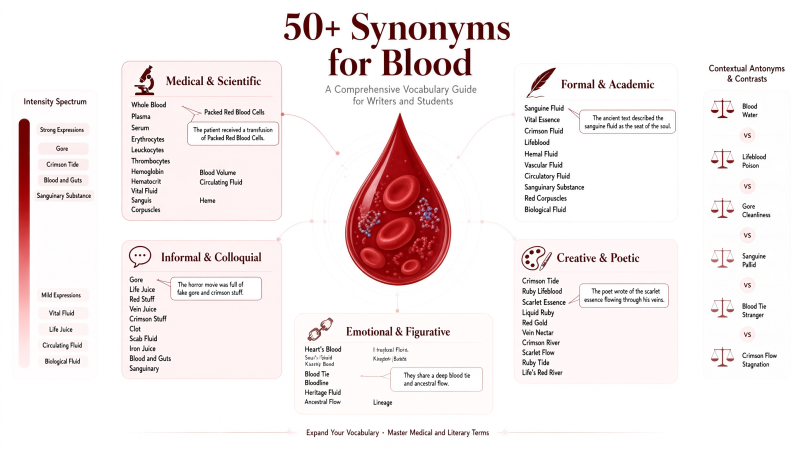
Blood is the red fluid that circulates through the body, transporting oxygen, nutrients, and waste products. Common alternatives include lifeblood, sanguine fluid, plasma, vital fluid, gore, and lineage, depending on the intended context.
Have you ever used the word blood repeatedly in an essay, story, article, or conversation and wondered whether another word would sound better? Finding the right alternative can make your writing more descriptive, professional, and engaging.
Whether you are discussing health, family relationships, ancestry, violence, or emotions, choosing the right synonym for blood depends on the meaning you want to communicate. Some alternatives are medically accurate, while others add literary imagery or emotional depth.
This guide explores 50+ synonyms for blood, their meanings, examples, differences, and the best alternatives for different writing situations.
Meaning, Tone and Context
Simple Definition
Blood is the red bodily fluid that travels through the circulatory system. It carries oxygen and nutrients to tissues, helps fight infections, and supports essential bodily functions.
The word also has figurative meanings associated with family connections, ancestry, heritage, violence, courage, and life itself.
Part of Speech
Blood is primarily used as a noun.
Examples:
- The blood carries oxygen throughout the body.
- The family has a long history of royal blood.
- Blood was visible on the floor after the accident.
It can also function as a verb in specialized expressions, such as blooding a hunting dog, meaning introducing it to its first experience of hunting.
Tone and Formality
| Feature | Description |
| Part of speech | Primarily a noun |
| General tone | Neutral |
| Formality | Suitable for formal and informal writing |
| Medical context | Biological and scientific |
| Emotional context | Personal, symbolic, or dramatic |
| Literary context | Descriptive and expressive |
| Common associations | Life, family, ancestry, violence, health |
Common Uses of Blood
Blood appears in several different contexts:
- Medical: Blood tests, blood pressure, blood circulation, and blood donation.
- Family: Blood relatives, blood relations, and family lineage.
- Literature: Blood as a symbol of life, sacrifice, courage, and death.
- Violence: Bloodshed, bleeding, and gore.
- Figurative language: Lifeblood, meaning something essential to survival or success.
Important Word Forms
| Word | Meaning |
| Blood | The red fluid circulating in the body |
| Bloody | Containing, covered with, or involving blood |
| Bloodless | Without blood or lacking vitality |
| Bloodshed | Killing or violence involving blood |
| Bloodline | A person’s family ancestry |
| Bloodstained | Marked or stained with blood |
| Bloodstream | The circulating blood within the body |
When and How to Use “Blood”
The word blood is appropriate whenever you need to describe the body’s circulating fluid or communicate a related idea involving family, life, or violence.
Here are realistic examples from different situations.
1. Medical: The doctor ordered a blood test to check my iron levels.
2. Academic: Blood transports oxygen and nutrients throughout the human body.
3. Personal: My brother and I share the same blood.
4. Emotional: She would do anything to protect her family because blood means everything to her.
5. Creative: The warrior’s blood stained the battlefield after the final battle.
6. Professional: The hospital needs additional blood donations to support emergency patients.
7. Social media: Donating blood is a simple way to help save lives.
Another Word for “Blood”
The best single replacement for blood depends on its intended meaning.
Lifeblood is a strong figurative alternative when describing something essential to survival or success. However, it is not a direct replacement for blood in medical or biological writing.
Here are some useful alternatives by situation.
| Context | Suggested Alternative |
| Professional writing | Circulating fluid |
| Academic writing | Blood, plasma, or whole blood |
| Casual conversation | Blood |
| Emotional writing | Lifeblood |
| Creative writing | Crimson fluid |
| Family relationships | Lineage |
| Resume or workplace use | Lifeblood, when used figuratively |
| Social media captions | Lifeblood or life force |
| Stronger meaning | Gore or bloodshed |
| Softer meaning | Bodily fluid |
Important: Plasma is a component of blood, not a complete synonym. Similarly, gore refers to blood and other bodily matter, particularly in violent or graphic situations.
When Not to Use “Blood”
Although blood is a common and versatile word, replacing it can improve clarity in certain situations.
Here are some examples.
| Original Sentence | Better Alternative | Why It Works |
| Blood carries oxygen through the body. | Circulating blood | More specific scientific description |
| The company is the blood of the economy. | The company is the lifeblood of the economy. | More natural figurative expression |
| He comes from royal blood. | He comes from royal ancestry. | More precise family meaning |
| The movie contained too much blood. | The movie contained too much gore. | Better for graphic violence |
| They share the same blood. | They share the same lineage. | Emphasizes family ancestry |
Avoid replacing blood with an alternative simply to make a sentence sound sophisticated. A precise, familiar word is often better than an unusual one.
Words Commonly Confused With Blood
Several words are associated with blood but have different meanings.
| Word | Meaning | Difference From Blood |
| Plasma | Liquid component of blood | Plasma is only one part of blood. |
| Hemoglobin | Protein that carries oxygen in red blood cells | It is a component associated with blood, not blood itself. |
| Gore | Blood and bodily matter, especially in violent scenes | It has a graphic or disturbing association. |
| Lymph | Clear fluid involved in the immune system | It belongs to the lymphatic system. |
| Serum | Liquid remaining after blood clots | It is not the same as whole blood. |
| Lineage | Family descent or ancestry | It describes relationships rather than bodily fluid. |
Understanding these differences helps you choose accurate vocabulary in scientific, professional, and creative writing.
Best Synonym by Context for Blood
Not every alternative works in every situation. The following table highlights suitable choices based on tone and meaning.
| Context | Best Synonym | Why It Works | Example |
| Formal writing | Circulating fluid | Descriptive and professional | The circulating fluid supplies oxygen. |
| Academic writing | Whole blood | Scientifically precise | Whole blood contains plasma and blood cells. |
| Medical writing | Hematic fluid | Technical descriptive terminology | The study examined blood related components. |
| Professional use | Lifeblood | Communicates importance | Employees are the lifeblood of the organization. |
| Resume or workplace | Lifeblood | Expresses essential contribution | Innovation is the lifeblood of our business. |
| Casual conversation | Blood | Natural and familiar | There was blood on his shirt. |
| Creative writing | Crimson fluid | Adds visual imagery | Crimson fluid covered the ancient blade. |
| Emotional writing | Lifeblood | Suggests deep importance | Her family was the lifeblood of her happiness. |
| Strong intensity | Gore | Creates a graphic impression | The horror movie featured excessive gore. |
| Soft or moderate tone | Bodily fluid | Less graphic and descriptive | The sample contained bodily fluid. |
| Social media captions | Lifeblood | Works well figuratively | Music is the lifeblood of my creativity. |
| Family relationships | Lineage | Communicates ancestry | Their lineage dates back generations. |
| British English | Blood | Standard British usage | Blood donation saves lives. |
| American English | Blood | Standard American usage | Blood donation helps patients. |
Which Synonym Should You Choose?
Choosing the right alternative involves understanding what you actually want to express.
Use these guidelines:
1. Consider the meaning: If you mean the fluid inside the body, use blood, whole blood, or another medically accurate term.
2. Think about formality: For academic and professional writing, prioritize precise scientific vocabulary rather than decorative expressions.
3. Consider emotional intensity: Lifeblood suggests importance, while gore creates a disturbing or violent impression.
4. Understand the context: Use lineage or ancestry when discussing family history instead of using blood repeatedly.
5. Avoid unnecessary complexity: A familiar word is better than an unusual alternative when both communicate the same idea.
6. Check the sentence: Read your sentence again after replacing the original word. Make sure the meaning remains accurate.
Real Life Examples of Blood in Sentences
Here are examples showing how blood and its alternatives work in everyday communication.
| Situation | Example Sentence |
| School | Blood carries oxygen to different parts of the human body. |
| Workplace | Our employees are the lifeblood of this company. |
| Academic writing | Whole blood consists of plasma and cellular components. |
| Conversation | I donated blood at the local hospital. |
| Social media | Blood donation can make a life changing difference. |
| The hospital is requesting additional blood donations. | |
| Storytelling | Crimson fluid slowly spread across the battlefield. |
| Family | Their family lineage can be traced back several generations. |
| Creative writing | The knight returned from battle with bloodstained armor. |
| Professional presentation | Customer trust is the lifeblood of a successful business. |
25 Synonyms for Blood
| Synonym | Simple Meaning | Best Used For | Example Sentence |
| Lifeblood | Something essential for survival | Figurative writing | Trust is the lifeblood of every relationship. |
| Hematic fluid | Blood or blood related fluid | Technical descriptions | The research examined hematic properties. |
| Sanguine fluid | Blood, described through literary terminology | Creative writing | The wound released sanguine fluid. |
| Crimson fluid | Red colored fluid | Poetry and fiction | Crimson fluid marked the stone floor. |
| Vital fluid | Fluid essential for life | Literary descriptions | The vital fluid supports the body’s functions. |
| Circulating fluid | Fluid moving through the body | Educational writing | The circulating fluid delivers oxygen. |
| Whole blood | Blood containing all its major components | Medical contexts | Whole blood was collected for testing. |
| Plasma | Liquid component of blood | Medical and scientific writing | Plasma transports nutrients throughout the body. |
| Serum | Fluid remaining after blood clots | Laboratory contexts | The laboratory analyzed the serum sample. |
| Gore | Blood and bodily matter | Horror and violence | The scene contained graphic gore. |
| Bloodshed | Violence involving blood and killing | News and storytelling | The conflict resulted in widespread bloodshed. |
| Hemoglobin | Oxygen carrying protein in red blood cells | Biology | Hemoglobin helps transport oxygen. |
| Bloodline | Family ancestry | Genealogy | She comes from a respected bloodline. |
| Lineage | Family descent | Formal writing | His lineage has a long history. |
| Ancestry | Family origins | Genealogy and history | Their ancestry can be traced through historical records. |
| Heritage | Inherited cultural or family background | Personal writing | She takes pride in her family heritage. |
| Kinship | Family or social relationship | Academic and personal writing | Their kinship was clear to everyone. |
| Blood relation | A relative connected by birth | Family discussions | He is a blood relation of the family. |
| Kindred | People related by family or shared qualities | Literary writing | They recognized each other as kindred spirits. |
| Bloodstain | A mark made by blood | Descriptive writing | Investigators examined the bloodstain. |
| Blood plasma | The liquid portion of blood | Medical writing | Blood plasma contains important proteins. |
| Blood corpuscles | Blood cells | Historical or technical writing | The sample contained numerous blood corpuscles. |
| Erythrocytes | Red blood cells | Scientific writing | Erythrocytes transport oxygen. |
| Hemolymph | Circulating fluid in many invertebrates | Biology | Hemolymph circulates through the insect’s body. |
| Life force | An essential energy associated with life | Philosophical and creative writing | The ancient story described blood as a life force. |
Synonym Groups and Usage Differences
Professional vs. Personal Synonyms
Professional writing usually requires accuracy and clarity. Personal writing can allow more expressive alternatives.
For example:
- Professional: Whole blood was collected for laboratory analysis.
- Personal: My family is the lifeblood of my happiness.
The first sentence communicates biological information, while the second expresses emotional importance.
Formal vs. Conversational Synonyms
Formal vocabulary works well in research papers, medical reports, presentations, and professional communication.
Conversational vocabulary should sound natural and easy to understand.
| Formal or Technical | Conversational | Best Context |
| Whole blood | Blood | Medical discussions |
| Erythrocytes | Red blood cells | Biology conversations |
| Lineage | Family background | Personal discussions |
| Ancestry | Family history | Everyday conversation |
| Lifeblood | Something essential | General discussions |
Academic Synonyms
Academic writing benefits from terminology that communicates specific scientific meanings.
Useful academic terms include:
- Whole blood
- Blood plasma
- Serum
- Hemoglobin
- Erythrocytes
- Hemolymph
- Circulating blood
For example, instead of writing:
“Blood contains different things that help the body.”
Write:
“Blood contains plasma, red blood cells, white blood cells, and platelets.”
The second sentence provides more precise scientific information.
Professional and Business Synonyms
In business communication, lifeblood is one of the most useful figurative alternatives.
It describes something that supports the success or continued operation of an organization.
Examples:
- Customer satisfaction is the lifeblood of our business.
- Reliable communication is essential to the company’s success.
- Employee commitment keeps the organization moving forward.
Avoid using medical terms such as hemoglobin or plasma as business synonyms.
Creative or Literary Synonyms
Creative writing often benefits from descriptive expressions that help readers imagine a scene.
Consider these alternatives:
- Crimson fluid
- Sanguine fluid
- Vital fluid
- Lifeblood
- Bloodstained substance
- Life force
Example:
“The crimson fluid glistened beneath the moonlight.”
This expression creates a stronger visual impression than simply writing, “The blood was visible.”
Slang or Modern Synonyms
Blood does not have many widely accepted modern slang synonyms that can replace it accurately.
However, certain informal expressions refer to family, close relationships, or shared identity.
| Expression | Meaning | Usage |
| Blood | A close relative or family connection | Informal |
| My blood | Someone closely connected by family | Personal |
| Blood brother | A person connected through a traditional symbolic bond | Informal or cultural |
| My people | A person’s close community | Casual |
These expressions are context dependent and should not be treated as universal replacements.
Strongest vs. Weaker Synonyms
Different words communicate different levels of intensity.
| Intensity | Word | Impression |
| Mild | Bodily fluid | Neutral and descriptive |
| Moderate | Blood | Direct and factual |
| Descriptive | Crimson fluid | Visual and literary |
| Emotional | Lifeblood | Important and meaningful |
| Strong | Gore | Graphic and disturbing |
| Very strong | Bloodshed | Violent and serious |
This is a descriptive scale rather than a strict ranking of interchangeable words.
Emotional vs. Neutral Synonyms
Neutral words communicate facts without adding unnecessary emotion.
Examples include blood, whole blood, plasma, and circulating fluid.
Emotional or expressive alternatives include lifeblood, life force, and kindred. They communicate deeper connections, importance, or symbolic meaning.
For example:
- Neutral: Blood is essential for human survival.
- Emotional: Her children are the lifeblood of her world.
Antonyms of Blood
Blood does not have a perfect direct antonym because it is a physical substance rather than an abstract quality.
However, some words describe contrasting conditions, substances, or figurative ideas.
| Antonym or Contrast | Meaning | Example Sentence |
| Bloodless | Without blood or lacking blood | The patient appeared bloodless. |
| Anemia | A condition involving insufficient healthy red blood cells or hemoglobin | The doctor diagnosed anemia. |
| Plasma free | Without plasma | The sample was plasma free. |
| Serum free | Without serum | The preparation was serum free. |
| Hemoglobin free | Without hemoglobin | The solution was hemoglobin free. |
| Colorless | Without color | The liquid appeared colorless. |
| Transparent | Allowing light to pass through | The fluid looked transparent. |
| Clear | Free from visible particles or cloudiness | The liquid remained clear. |
| Pallor | Unusual paleness | His face showed noticeable pallor. |
| Paleness | Lack of normal skin color | Her paleness concerned the doctor. |
| Lifelessness | Lack of vitality | The character’s lifelessness was noticeable. |
| Death | The end of life | The story explored themes of life and death. |
| Vitality | Energy and liveliness | Exercise can improve vitality. |
| Life | The state of being alive | The medicine helped save a life. |
| Nonviolence | Avoidance of physical violence | The movement promoted nonviolence. |
Important: These are contextual contrasts, not 15 exact dictionary antonyms. Blood has no standard set of 15 direct antonyms.
Comparison: Blood vs. Similar Words
Understanding similar words helps prevent inaccurate substitutions.
Blood vs. Plasma
Main difference: Blood is the complete circulating fluid, while plasma is its liquid component.
Stronger: Blood refers to the entire substance.
More formal: Both are appropriate in medical writing.
Examples:
- Blood carries oxygen and nutrients throughout the body.
- Plasma transports proteins and other substances.
Blood vs. Serum
Main difference: Serum is the liquid remaining after blood has clotted.
Stronger: Blood refers to the complete fluid.
More formal: Both are scientific terms.
Examples:
- Blood samples were collected from the patients.
- Serum samples were analyzed in the laboratory.
Blood vs. Gore
Main difference: Blood is a neutral biological term, while gore usually describes blood and bodily matter in graphic or violent situations.
Stronger: Gore creates a more disturbing impression.
More formal: Blood is more suitable for general professional communication.
Examples:
- There was blood on the patient’s clothing.
- The horror movie contained graphic gore.
Blood vs. Lifeblood
Main difference: Blood describes a physical substance, while lifeblood usually refers to something essential for survival or success.
Stronger: Lifeblood can communicate greater figurative importance.
More formal: Both can work in professional writing, depending on context.
Examples:
- Blood circulates through the human body.
- Innovation is the lifeblood of the technology industry.
Blood vs. Lineage
Main difference: Blood can refer figuratively to family connections, while lineage specifically means family descent.
Stronger: Neither is universally stronger.
More formal: Lineage is more precise for genealogy.
Examples:
- They share the same blood.
- Their lineage can be traced through historical records.
Blood vs. Ancestry
Main difference: Blood can refer to family relationships, while ancestry describes someone’s family origins and previous generations.
Stronger: Blood may sound more emotional.
More formal: Ancestry is suitable for historical and academic writing.
Examples:
- They are connected by blood.
- She researched her ancestry for a family history project.
Common Phrases and Expressions with Blood
Blood appears in many familiar English expressions. Understanding these phrases can improve vocabulary and everyday communication.
1. Blood Is Thicker Than Water
Meaning: Family relationships are often considered stronger than other relationships.
Example sentence: My parents always remind me that blood is thicker than water.
2. Make Someone’s Blood Boil
Meaning: To make someone extremely angry.
Example sentence: His disrespectful comments made my blood boil.
3. Cold Blood
Meaning: A lack of emotion or sympathy, especially when someone commits a cruel act.
Example sentence: The criminal committed the murder in cold blood.
4. Sweat Blood
Meaning: To work extremely hard or experience considerable worry.
Example sentence: She sweated blood to finish the project before the deadline.
5. Blood, Sweat, and Tears
Meaning: A great deal of effort, hard work, and sacrifice.
Example sentence: Building this business took years of blood, sweat, and tears.
6. New Blood
Meaning: New people bringing fresh ideas or energy to a group.
Example sentence: The company needs some new blood to encourage innovation.
7. In Someone’s Blood
Meaning: Something that feels natural or deeply ingrained in someone’s personality or family background.
Example sentence: Music is in her blood because several generations of her family were musicians.
8. Bad Blood
Meaning: Feelings of anger, resentment, or hostility between people.
Example sentence: There has been bad blood between the two families for years.
Common Mistakes to Avoid
Even familiar vocabulary can create confusion when used incorrectly.
Here are seven common mistakes to avoid.
1. Treating Plasma as a Complete Synonym
Plasma is only the liquid component of blood. It cannot replace blood in every medical or scientific sentence.
Incorrect: Plasma carries oxygen through the body as a complete blood substitute.
Better: Blood carries oxygen throughout the body.
2. Confusing Blood With Lineage
Blood can refer to family connections, but lineage specifically describes family descent.
Incorrect: Her blood can be traced through historical family records.
Better: Her lineage can be traced through historical family records.
3. Using Technical Words in Casual Conversation
Terms such as erythrocytes and hemolymph can sound unnecessarily complicated in everyday discussions.
Choose familiar expressions when communicating with a general audience.
4. Using Gore in Medical Writing
Gore describes graphic or disturbing material, not the normal biological substance.
Incorrect: The laboratory examined the gore sample.
Better: The laboratory examined the blood sample.
5. Using Overly Dramatic Expressions
Expressions such as crimson fluid and sanguine fluid may work in fiction, but they can sound unnatural in ordinary writing.
Use them only when descriptive language adds value.
6. Repeating Blood Too Often
Repeating the same word can make writing less engaging.
Instead, consider the intended meaning.
For example:
“Blood connects several generations of the family.”
Could become:
“Family lineage connects several generations.”
7. Choosing the Wrong Emotional Tone
Lifeblood, gore, and bloodshed communicate very different ideas.
Always consider whether your sentence is medical, emotional, figurative, or descriptive before selecting an alternative.
FAQs
1. What Is the Best Synonym for Blood?
Lifeblood is a useful figurative synonym for something essential to survival or success. For biological meaning, blood itself is usually the most accurate word.
2. What Is a Formal Synonym for Blood?
Whole blood and circulating fluid are useful formal alternatives in scientific contexts. The best choice depends on whether you mean complete blood or its movement.
3. What Is an Informal Synonym for Blood?
Blood itself is the most natural everyday term. In family contexts, people sometimes use expressions such as blood relatives or my blood.
4. What Is Another Word for Blood in Professional Writing?
Whole blood, circulating blood, and plasma are useful professional terms when scientifically accurate. Lifeblood works well when describing something essential to business success.
5. What Is the Difference Between Blood and Plasma?
Blood is the complete circulating fluid containing plasma and blood cells. Plasma is the liquid portion that carries nutrients, proteins, and other substances.
6. What Is the Opposite of Blood?
Blood has no exact opposite. Depending on context, contrasting terms include bloodless, colorless, and lifelessness, although none is a universal antonym.
Conclusion
Blood is an important English word with biological, emotional, familial, and figurative meanings. Choosing the right alternative depends on the message, tone, and situation.
For scientific writing, terms such as whole blood, plasma, and erythrocytes provide greater precision. For creative writing, expressions such as crimson fluid and sanguine fluid add descriptive depth. When discussing family connections, lineage and ancestry are often more appropriate.